Executing a High-Impact Fashion Model Photoshoot
Transform your fashion model photoshoot from concept to campaign. This expert guide details casting, on-set direction, and post-production for stunning results.
Nov 5, 2025
published
Pulling off a high-impact fashion model photoshoot is an art form, one that hinges on a delicate balance between creative vision and razor-sharp logistics. This guide is your backstage pass, breaking down the entire process into real, actionable steps to help you create campaigns that truly connect. We’re going to skip the theory and get straight to the practical strategies that lead to powerful, unforgettable imagery.
Your Roadmap to a Flawless Fashion Photoshoot
A truly great fashion shoot is so much more than a model and a camera. It’s a carefully choreographed performance where every single element—from the first spark of an idea to the final image—works together to tell a compelling story. This demands a mix of artistic instinct and serious project management. As a photographer, my job is to protect the creative vision while juggling all the logistical realities of production.
Think of it like you're directing a tiny film. Your shoot needs a narrative, a lead (the model), a set, and a specific mood. The ultimate goal? To capture that one perfect frame that tells the whole story in an instant. That’s what separates a forgettable catalogue shot from an iconic campaign image that comes to define a brand. For instance, the raw, rebellious energy of a classic Calvin Klein campaign is a deliberate narrative choice, just as much as the opulent, dreamlike quality of a Dior ad.
The Three Pillars of a Photoshoot
No matter the scale, every shoot is built on three core pillars: Vision, Execution, and Delivery. Understanding how these stages flow into one another is the first real step toward getting professional results. They aren't just a checklist; they're a continuous process where each phase builds on the last.
This infographic lays out the typical workflow for a professional fashion shoot.
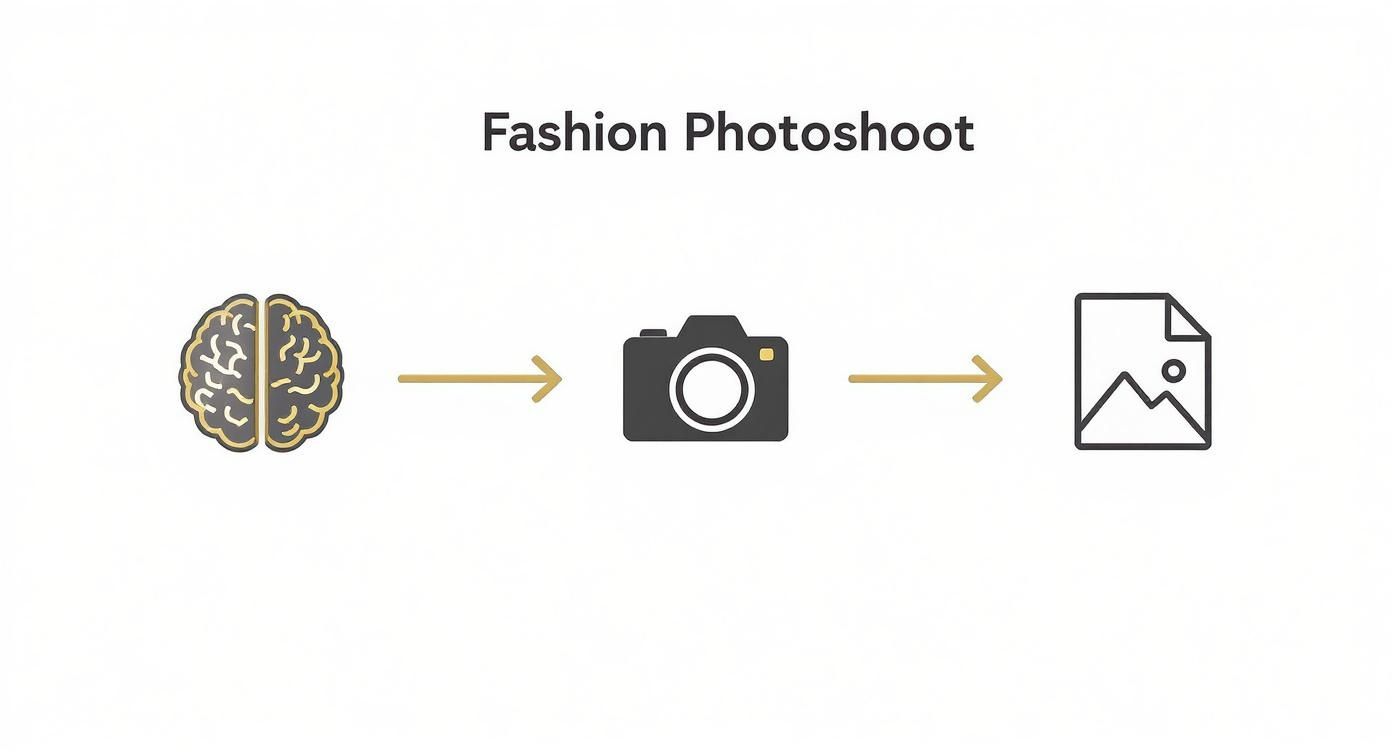
As you can see, a strong, clear vision isn't just a nice-to-have. It’s the foundation that determines the quality and direction of everything that follows, from what happens on set to the final assets you deliver.
More Than Just Pictures: A Booming Industry
The relentless demand for high-quality fashion imagery isn't just about art; it's a massive economic engine. This is particularly true in fast-growing markets where fashion and e-commerce are exploding.
Take India, for example. The India Photography Services Market was valued at roughly USD 6.79 billion and is expected to grow at a CAGR of 8.1% through 2033. A huge chunk of that growth comes from commercial photography, where fashion shoots are the lifeblood of advertising, branding, and social media.
"The difference between a good photo and an amazing photo is the story it tells. On set, my primary job is to create an environment where that story can unfold authentically, guided by the brand's vision but brought to life by the entire creative team."
This is the key takeaway. Technical skill is vital, but it has to be paired with strong direction and a collaborative spirit. The best way to understand this is to see it in practice. Diving into a portfolio of successful projects can show you exactly how different brands bring their unique stories to life. You can see these principles in action across these diverse advertising and fashion photography projects.
Translating Vision Into a Tangible Plan
A great fashion photoshoot is made long before anyone steps in front of the camera. The real magic happens in the concept phase, where we take an abstract idea and forge it into a concrete, actionable plan. This is where we decide the story we want to tell, the feeling we want to evoke, and the visual language that will define the entire campaign.
Think of it this way: every single choice, from the model we cast to the colours we select, must support that central narrative. I've seen shoots falter because the initial concept was too vague, leading to a disjointed shoot and a confused message. But a sharp, well-defined plan gets the entire creative team on the same page, all pulling in the same direction.
Building Your Visual Blueprint
The first order of business is to get out of words and into visuals. Your single most powerful tool for this is the mood board. It’s so much more than a collage of nice images; it’s the visual soul of the photoshoot, a contract that everyone on the team can understand at a glance. I often start on a platform like Pinterest for wide-ranging inspiration, then pull the strongest, most relevant ideas into a refined board on Milanote to share with the team.
This visual blueprint needs to nail down a few key elements:
Colour Palette: Are we going for warm, earthy tones reminiscent of a Sabyasachi campaign, or something cool, sharp, and minimalist like a COS ad?
Lighting Style: Does the story call for soft, diffused light for a clean commercial look, or are we chasing hard, dramatic shadows for that high-fashion editorial feel?
Emotional Tone: Should the model project power and confidence, or is the mood softer and more ethereal?
Posing and Movement: What kind of body language tells our story? Include reference shots of poses that fit the narrative.
Styling Direction: This is where you show the textures, silhouettes, and accessory styles that will bring the collection to life.
Once your vision is clear, you need to document it. This is where your mood board grows into a full-blown creative brief. For an excellent guide on this, check out this resource on how to write a creative brief that will ensure your entire team is aligned on the shoot's goals and aesthetics.
The Art and Science of Casting
With a strong visual direction locked in, casting becomes less of a guessing game and more of a strategic mission. You aren't just looking for a "good-looking" person. The right model embodies the brand's story and forges an emotional connection with your target customer. This one decision can ripple through the campaign's message, logistics, and, of course, the budget.
Think about the difference in casting strategy between a heritage brand like Sabyasachi, which often features culturally resonant Indian models to strengthen its local connection, and a global powerhouse like Zara, which uses a diverse roster of international faces to create a cosmopolitan, universal appeal. Both are deliberate choices, made for a specific purpose. The model's personality and background are just as crucial as their look.
Your model is the human element of your brand's story. Casting isn't about finding a perfect person; it's about finding the right person to convey a specific feeling and narrative.
When deciding between local and international talent, there are significant downstream effects to consider. This choice is about finding the sweet spot between authenticity, market appeal, and practical feasibility.
Here's a quick breakdown to help guide that decision:
Key Decision Factors for Model Casting
Casting Factor | Local (Indian) Models | International Models |
|---|---|---|
Audience Connection | High resonance with the domestic market; strong cultural relatability. | Broader, cosmopolitan appeal; often perceived as aspirational or "global". |
Cost & Logistics | Generally more cost-effective. Simpler logistics (no visas, less travel). | Higher fees and agency costs. Requires visa processing, international travel, and accommodation. |
Availability | Large and growing talent pool. Easier to book for last-minute shoots. | Requires longer lead times for booking and travel arrangements. |
Look & Aesthetic | Offers a wide range of looks that are authentic to the Indian market. | Provides diverse, often very specific, looks that may not be available locally. |
Campaign Goal | Ideal for campaigns targeting the Indian consumer or celebrating local heritage. | Best for brands with a global presence or those aiming for an international aesthetic. |
Ultimately, India’s fashion and modelling industry has exploded in recent years, with a fantastic surge in homegrown talent. Indian models are incredibly versatile and bring an authenticity that’s hard to replicate, making them a powerful choice for brands wanting to tell a genuine story.
Getting this right is about aligning the perfect face with a powerful brand story. You can see how these decisions play out across different campaigns in our fashion and advertising photography blog.
Mastering On-Set Direction and Production
All the meticulous planning is done. The vision is set, the team is ready. Now, we arrive at the moment of truth: the shoot day itself. This is where all that preparation meets performance, and your ability to direct your talent while wrangling the production logistics will make or break the final images.
A successful shoot day often feels like a masterclass in controlled chaos. It demands a calm, authoritative presence that can steer the creative energy while keeping a sharp eye on the clock. Remember, every minute on set costs money, so efficiency is everything.
Orchestrating the Perfect Shoot Day
The secret to a smooth production almost always comes down to one document: the call sheet. This isn't just a schedule; it's the operational bible for the day. A truly robust call sheet clears up any confusion before it starts and empowers every single person on your team to do their job effectively.
A battle-tested call sheet must include:
Key Contacts: A complete list of names, roles, and mobile numbers for the entire cast and crew. No exceptions.
Location Details: The exact address, a map link, clear parking instructions, and contact info for anyone on-site.
Comprehensive Schedule: Detailed call times for everyone (MUA, stylist, model, photographer), along with scheduled breaks and a projected wrap time.
Contingency Plans: This is absolutely critical for outdoor shoots. Note the backup location or rain plan. This tiny detail can single-handedly save an entire production.
This level of detail is non-negotiable for large-scale campaigns. On a complex shoot like the Dubai Tourism "Be My Guest" campaign with Shah Rukh Khan, a meticulous call sheet is the only thing standing between seamless execution and absolute chaos when coordinating multiple locations and high-profile talent.
The Art of Directing a Genuine Performance
With logistics under control, my main role shifts from producer to director. My job now is to build an atmosphere where the model feels comfortable, confident, and free to experiment. A tense set leads to stiff, awkward poses. A supportive one, however, encourages the authentic emotion that makes an image truly connect with the viewer.
The best directors give clear, actionable feedback. Ditch vague instructions like "look more confident." Instead, give them a story or a feeling to work with. Rather than saying "look fierce," try something like, "You're walking into a room and you own it; everyone's eyes are on you." This provides a character to inhabit, which almost always results in more natural expressions and body language.
A director's true skill is communication. It’s a delicate balance of authoritative vision and collaborative energy that transforms potential chaos into iconic imagery. You have to command the set while making your talent feel like the most important person there.
This approach is clear in the work of India's most influential photographers. The rise of iconic names has been fundamental in shaping the visual identity of Indian fashion. Photographers like Atul Kasbekar, famous for his work on the Kingfisher Calendar, have launched the careers of supermodels like Deepika Padukone and Katrina Kaif. His ability to fuse glamour with artistic expression on set creates powerful photoshoots that consistently set new industry benchmarks.
Embracing the Unexpected
No amount of planning can prepare you for everything. A sudden downpour, a piece of gear failing, a wardrobe malfunction—these are just part of the job. Your ability to adapt and make quick, decisive calls under pressure is what separates a seasoned professional from an amateur.
Always have a Plan B, and honestly, a Plan C as well. If the weather turns, is there an indoor location already scouted? If a light breaks, does your assistant know the nearest rental house? Thinking through these "what-if" scenarios beforehand means you can pivot without panic, keeping the creative momentum alive and ensuring the final images are a product of your vision, not a compromise forced by bad luck.
Bringing the Vision to Life With Light, Gear, and Styling
Once your creative direction is locked in, the real artistry begins. The success of a fashion model photoshoot boils down to the hands-on execution of three core elements: lighting, camera gear, and styling. These aren’t just technical checkboxes; they're the tools I use to translate an abstract mood board into a tangible, powerful image.
Think of these three pillars as an interconnected triangle. Lighting sculpts the mood, your gear dictates the perspective, and styling cements the narrative. Every choice must be intentional, serving the story you’re ultimately trying to tell.
Sculpting the Scene with Light
Lighting is so much more than just making sure your subject is visible. It’s about creating emotion, depth, and dimension. The way you shape light can completely transform the story an image tells, and moving beyond a basic three-point setup is where you’ll start to define a signature style.
For a dramatic, high-fashion editorial, you might use a single, hard light source placed off to the side. This is often called "chiaroscuro lighting," and it’s perfect for carving out deep, intense shadows that accentuate the model's features. It’s a bold, confident choice that immediately adds a sense of mystery.
A commercial beauty campaign, on the other hand, calls for the complete opposite. The goal there is usually soft, even, and incredibly flattering illumination. You’ll achieve this with large light sources like octaboxes or softboxes, often paired with reflectors to gently fill in any shadows. This approach wraps the model in a beautiful, clean light that smooths skin texture and creates that aspirational look brands crave. Understanding this distinction is vital, especially when executing precision-driven beauty and hair photography campaigns.
Choosing Your Lens: Your Narrative Tool
Don't think of your camera and lens as just technical gear; they are your primary storytelling instruments. The focal length you select has a direct impact on how the viewer perceives the model and the world around them, fundamentally shifting the entire feel of the photograph.
A classic 50mm prime lens, often affectionately called a "nifty fifty," renders a scene much like the human eye does. This creates a natural, intimate connection, making it perfect for portraits where you want the viewer to feel like they're right there with the model. The result feels honest and grounded.
Contrast that with a 16-35mm wide-angle lens. This lens will push the background further away and can create powerful, dramatic distortion when you get in close. It's a fantastic choice for an epic environmental story. Picture your model in a vast, sweeping landscape—the wide-angle lens will exaggerate the scale of the surroundings, making the entire scene feel grand and cinematic.
The lens you choose is the perspective you're asking the audience to adopt. A telephoto lens makes them a distant observer, while a wider lens pulls them directly into the scene.
The Stylist’s Final Touch
A great stylist does so much more than just pick out clothes. They are a visual storyteller, an on-set problem-solver, and a master of the smallest details. Their job is to make sure every fabric, accessory, and silhouette not only fits the narrative but elevates it.
The stylist’s kit is a treasure chest of tricks that make the magic happen. That perfect fit you see in a magazine is almost never straight off the rack.
Clamps and Pins: These are the secret weapons used on the backside of garments to create that flawless, tailored silhouette that fits the model’s form perfectly.
Double-Sided Tape: An absolute essential for keeping a plunging neckline in place or preventing a collar from flapping around. It ensures a clean, polished look without any wardrobe mishaps.
A Steamer: Wrinkles can kill a shot. A good stylist is almost always steaming garments between looks to ensure every piece of fabric looks absolutely pristine on camera.
This is the kind of meticulous attention to detail that separates a good shot from an iconic one. It’s about making sure every single element in the frame feels intentional and works together to complete the visual story.
Polishing and Delivering Your Final Assets
The shutter might have stopped clicking, but the creative work is far from over. Post-production is where the raw captures from your fashion shoot are meticulously sculpted into the polished, high-impact assets that will define the campaign. This is your last chance to refine the story, lock in the mood, and ensure every single image speaks the brand's language flawlessly.

It all starts with a disciplined and efficient culling process. You’ll likely have thousands of shots, and your first job is to hunt for the “hero” images—those selects that perfectly capture the energy, emotion, and narrative you set out to create. This isn't just about finding the technically perfect photos; it’s about pinpointing the moments that truly connect.
The Art of Retouching and Colour Grading
With your selects in hand, the real magic begins. Professional retouching is a delicate dance. The aim is to clean up tiny distractions—a stray hair, a minor blemish on the skin, a distracting element in the background—without ever compromising the authenticity of the shot. Nothing kills a great photo faster than over-retouching; it can look artificial and immediately create a barrier with the audience.
The golden rule? Maintain natural skin texture. Today’s audiences crave authenticity, so preserving that human element is non-negotiable. Think of it as perfecting the image, not creating a plastic doll. A great retoucher’s work is invisible; they enhance, they don't erase.
Next up is colour grading, the step that truly cements the campaign's atmosphere. Colour is a potent emotional tool. A warm, slightly desaturated grade might evoke a sense of vintage nostalgia, making it ideal for a heritage brand. On the flip side, a cool-toned, high-contrast treatment feels modern, sharp, and edgy—perfect for a new streetwear label. Consistency is everything. Every image must share the same colour DNA to build a cohesive and powerful brand story. Just look at the striking visuals in the mCaffeine Lip Scrub Balm campaign; you can see how a consistent grade across macro beauty shots builds an unforgettable product narrative.
Post-production is your final opportunity to speak the brand's visual language. Your retouching should be invisible, but your colour grade should be unforgettable.
Packaging and Delivering Final Campaign Assets
Your work isn't finished until the client has everything they need to roll out a successful multi-platform campaign. A professional delivery package isn't just a folder of images; it's a comprehensive and thoughtfully organised toolkit designed to anticipate the client’s every need. This means providing a full suite of assets already optimised for every channel, from billboards to Instagram stories.
To truly showcase the quality of your work, it’s vital to understand how to present the final assets. You can find brilliant inspiration by looking at top-tier fashion design portfolio examples, which masterfully curate and display the finished product.
A clear, organised delivery checklist is crucial. It ensures the client can deploy the assets immediately, without the back-and-forth of requesting different versions.
Here’s a look at what should be included in your final delivery.
Essential Photoshoot Deliverables Checklist
This table outlines the standard formats you should prepare to cover all bases for a modern campaign launch.
Asset Type | Technical Specification | Primary Use Case |
|---|---|---|
Full-Resolution TIFFs | 300 DPI, Adobe RGB/ProPhoto RGB | High-quality print (billboards, magazines) |
High-Resolution JPEGs | 300 DPI, sRGB Colourspace | Website banners, press kits, general print |
Web-Optimised JPEGs | 72 DPI, sRGB, Sized for web use | E-commerce sites, blog posts, digital lookbooks |
Social Media Crops | 1:1 Square, 4:5 Portrait, 9:16 Story | Instagram Feed, Instagram Stories, Facebook |
Delivering a well-organised package with a variety of crops and resolutions makes the campaign activation process seamless for your client. More than that, it solidifies your role not just as a photographer, but as a strategic creative partner truly invested in the brand’s success.
Frequently Asked Questions
Planning a professional fashion photoshoot can feel like navigating a maze, especially with significant time and money on the line. I often get asked the same key questions by brands and agencies stepping into this world. Here are some straightforward answers based on years of experience in the field.
How Much Should I Realistically Budget for a Fashion Photoshoot?
There’s no magic number here; budgets can swing wildly depending on what you’re trying to achieve. A tight, editorial-style shoot with a small, nimble crew might land somewhere around ₹1,50,000. On the other hand, a full-blown commercial campaign involving multiple models, sought-after locations, and a large production team can easily climb past ₹15,00,000.
Think about your budget in three main buckets:
Your Creative Team: This is for your photographer, models, stylist, and hair and makeup artists. Their experience level will be the biggest factor here.
Production and Logistics: This covers everything from studio or location fees and permits to equipment rental, on-set catering, and travel.
Post-Production: Never forget this part. High-quality retouching and expert colour grading are crucial for a polished final product, and they come with their own costs.
Here’s a piece of hard-won advice: always build a 15-20% contingency into your budget. Trust me, something unexpected always comes up. It could be needing an extra hour in the studio or a last-minute prop run. That buffer ensures a small hiccup doesn’t derail your entire creative vision.
What's the One Thing That Makes or Breaks a Shoot?
If I had to pick just one thing, it's the clarity and strength of the creative concept. Everything else flows from this. Your concept is the guiding light for every single decision, from who you cast and how you light them to the location you choose and the final feel of the images.
I’ve seen shoots with the best team and a huge budget fall flat because the core idea was weak. On the other hand, a simple shoot with a powerful, unified vision can create iconic images. A strong concept is what ensures everyone is pulling in the same direction, creating a campaign that feels intentional, powerful, and true to your brand.
How Do I Find the Perfect Model for My Brand?
This is about more than just finding a pretty face. You're casting a character who needs to live and breathe your brand's story. Start by creating a detailed profile of the person you want to represent you. Are they edgy and rebellious? Sophisticated and aspirational? Write it down.
With that profile in hand, connect with reputable modelling agencies that get your brand. When they send you options, ask for more than just the polished portfolio. You need to see their "digitals" (sometimes called "polaroids") – simple, unretouched photos that show what the model really looks like without professional lighting and makeup.
For a major campaign, a live casting call is non-negotiable. It’s your chance to see how a model moves, how they interpret direction, and whether their personality shines through. The right model doesn’t just wear the clothes; they bring the entire brand attitude to life right in front of the camera.
At Harnesh Joshi, we mix sharp creative direction with meticulous execution to bring brand visions to life. If you’re ready to create visuals that don’t just get seen but get felt, let's talk about your next project. Explore our full range of services and see our work.
Article created using Outrank